Pelvic Organ Prolapse Treatment in Palm Desert
Pressure, heaviness, the sense that something is sitting lower than it should by the end of the day. You were told it comes with having babies, or that the choices are a pessary and surgery. Neither is the whole answer.
What causes pelvic organ prolapse?
Prolapse happens when the support under your pelvic organs stops holding the way it used to, so the bladder, the uterus, or the rectum settles lower into the vaginal wall. That support is muscle, fascia, and ligament working as one system, which means prolapse is a mechanical problem with mechanical causes. Almost none of them are about you doing something wrong, and most of them respond to training the system that gave way.
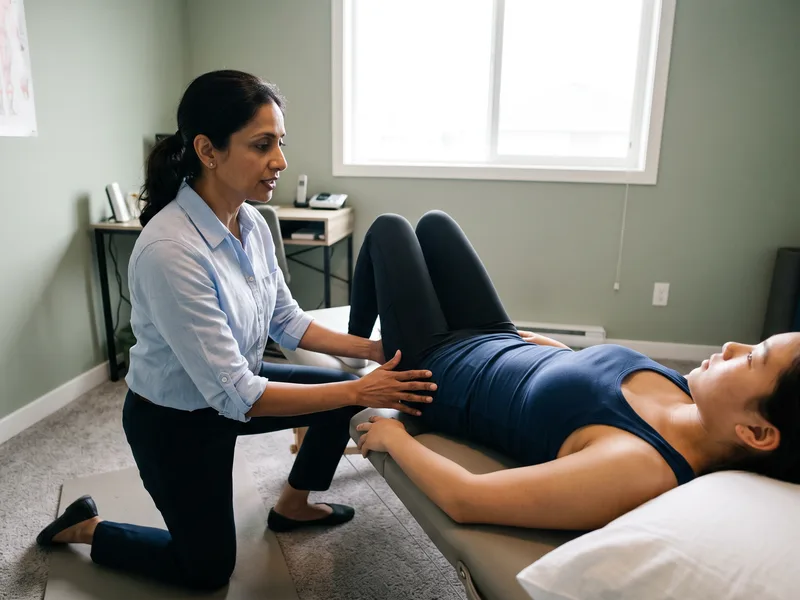
Carrying a pregnancy loads the pelvic floor for months, and a vaginal birth stretches those muscles and the fascia around them further than they go at any other time. Nerve supply to the area can be affected too, which is why a floor sometimes feels slow to respond rather than simply weak. Symptoms can appear weeks after a birth or years later, when a new demand arrives. There is no window that closes on treating it.
Every hard push on the toilet drives pressure down into the same tissues that hold your organs up. Do that daily for years and the support loses ground. A long-running cough from allergies, asthma, or smoking does the same thing over and over, hour after hour. This is why bowel habits and breathing belong in a prolapse plan: if the downward pressure keeps arriving, strengthening alone cannot outpace it.
Lifting is not the problem. Lifting while bracing hard and holding your breath is, because it turns your abdomen into a sealed pressure cylinder with one soft exit at the bottom. Toddlers, laundry baskets, patients, and barbells all count. We look at how you breathe under load, then retrain the timing so pressure is shared by the whole trunk instead of dumped onto your pelvic floor.
Removing the uterus changes how the top of the vagina is anchored, and scar tissue changes how nearby layers glide and share load. Prolapse of the vaginal wall can show up months or years after a hysterectomy in someone who had no symptoms before it. That is not a surgical failure and it is not your body failing either. It is a structural change that the surrounding muscles can be trained around.
Some people are simply built with more flexible connective tissue, which is why prolapse turns up without a birth, a surgery, or a heavy job anywhere in the history. Falling estrogen around and after menopause also thins vaginal tissue and reduces its resilience. You cannot change your collagen or your hormones with exercise, but you can change how much load reaches those tissues, and that usually changes what you feel.
How physical therapy in Palm Desert helps.
Prolapse gets graded by how far something has descended, but what you feel does not follow that grade neatly. Plenty of people with a visible prolapse have no symptoms, and plenty with a small one feel heavy by three in the afternoon. The symptoms are the part we can change. Your evaluation with Dr. Sarah Hare, PT, DPT, PCES, is a full hour: how you breathe, how your abdominal wall and diaphragm coordinate with your pelvic floor, whether those muscles can contract, fully relax, and hold under real load, and what your ordinary day does to the pressure inside your abdomen. The plan that follows is specific. Strength where the floor is weak, down-training where it is gripping, bowel mechanics so you stop pushing, and a way to lift and train that keeps pressure off the vaginal wall.
Two questions come up on nearly every first call. The first is about a pessary or surgery. Pelvic floor therapy is usually tried first, and for many people it is enough to make symptoms manageable and keep them that way. It also helps a pessary fit and work better if you choose one, and it improves what you take into surgery and what you recover with if you eventually need it. Nothing here rules those options out, and you will be told plainly if a referral makes sense. The second question is about the exam. An internal assessment gives the clearest picture of what your pelvic floor is doing, and it is always your choice: explained before anything happens, declinable at any point, with a great deal of effective work done externally. Bodies of every size, trans and nonbinary patients, and people whose symptoms were waved off elsewhere are routine here.
What to expect from your recovery.
Evaluation and an honest picture
Your first visit is a full hour with Dr. Hare, in the clinic. You get an assessment of your pelvic floor, hips, abdominal wall, and breathing, an explanation of what is producing the heaviness, and a plan you understand before you leave. If something needs a physician, you hear that too.
Pressure management and targeted strength
Next we lower the load reaching your pelvic floor and build what has to hold it. Bowel mechanics that do not require pushing, breathing that does not brace, hands-on work where tissue is restricted, and progressive pelvic floor and hip strengthening. Symptoms usually ease first in the evening, which is when most people notice them most.
Back to lifting, walking, and training
The goal is not a smaller life. It is a body that handles the one you have. We rebuild toward the specific things you stopped doing, whether that is a toddler on one hip, a morning hike, or a barbell, and you leave with the short maintenance routine that keeps symptoms from creeping back.
I would highly recommend working with Sarah for pelvic floor or other physical therapy needs.
Pain rarely travels alone.
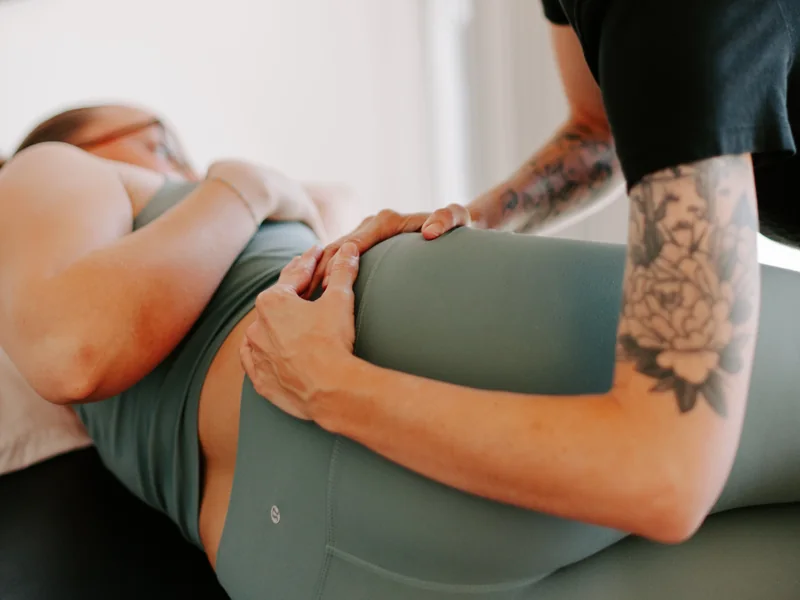
Bladder & Bowel Dysfunction
Leakage, urgency, retention, or constipation. These are muscle and coordination problems, and they are treatable.
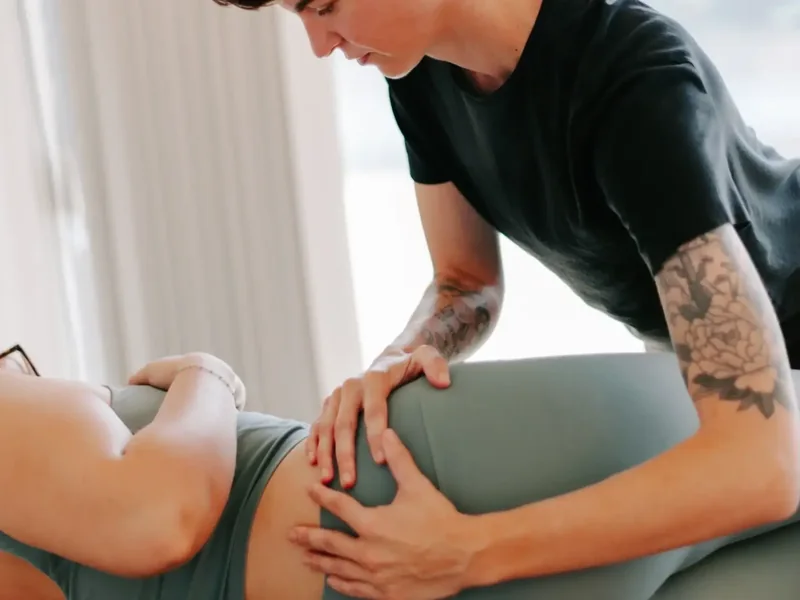
Abdominal Pain
Scar tissue, visceral restriction, and a core that stopped firing. We work the abdomen the way we work any other joint.

Tailbone Pain
Coccyx pain from a fall, a birth, or years of sitting. Internal and external work releases what is pulling on it.