Hip & Knee Pain Treatment in Palm Desert
The first few minutes are fine, then the ache builds and you start editing your day around it. You were probably told to strengthen the knee. Nobody checked the hip above it or the foot below it.
What causes hip and knee pain?
Weight-bearing joints almost never fail on their own. The knee sits between the hip and the foot and answers for both of them, and the hip answers for the pelvis above it. So the joint that hurts is often the one absorbing a problem that started somewhere else. That is why the exam covers the level above and the level below the pain every time, instead of only the spot you pointed at.
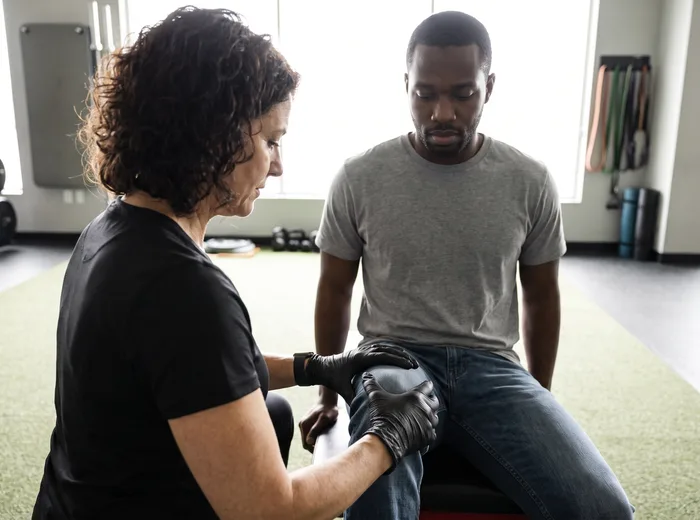
Your kneecap has to track through a groove at the end of the thigh bone. When the hip rotators are weak or the arch collapses inward, that groove effectively shifts underneath the kneecap, and the tissue behind it gets irritated a few thousand times per walk. It shows up on stairs, on hills, and after sitting with the knee bent. The knee is usually not the weak link. The hip is, and the knee is where you get the bill.
Impingement means the ball and socket are running out of clearance, usually at the front of the hip, so deep bending pinches. A labral tear is a fray in the cartilage rim that seals the socket, and it often reads as a catch, a click, or a deep groin ache that no stretch touches. Not every labral tear needs surgery. Changing how the hip is loaded and how the deep rotators control it takes pressure off the pinch point.
The IT band is a thick sheet of connective tissue running from the hip down the outside of your thigh. It is less tight than it is overloaded, and it gets loaded most when the glutes stop controlling how far the pelvis drops on each step. The pain lands on the outside of the knee, usually at a predictable distance into a run or a hike. Rolling it helps for an hour. Building the hip is what changes the distance.
Some knees and hips hurt less than they feel unreliable. The joint shifts, buckles, or has a moment on uneven ground where you simply do not trust it. That is usually a control problem rather than a structural one: the stabilizers fire late, and your body is guessing about where the joint actually is. Balance and reaction work rebuilds that sense of position, and strength gives the joint something to hold onto.
A new joint is the start of the work, not the end of it. Range of motion, gait retraining, and progressive strength decide how that joint feels a year later, and the leg stays weaker for longer than most people expect. Every session is a full hour with the same clinician, which matters when you are relearning stairs.
When a hip has been treated for months and keeps flaring, the pelvic floor is worth checking. Those muscles attach inside the pelvis and share space with the deep hip rotators, so a pelvic floor holding tension can keep a hip irritated no matter how well the glutes are trained. Deep groin pain, pain that lingers long after sitting, or hip pain that started during a pregnancy are all reasons to assess it properly.
How physical therapy in Palm Desert helps.
Hips and knees respond well to physical therapy, but only when the plan is aimed at the right joint. Your evaluation is a full hour with Dr. Sarah Hare, PT, DPT, PCES, and it does not stop at the joint that hurts: the ankle below it, the hip and pelvis above it, and how you load them walking, squatting, and climbing stairs are all part of the answer. Hands-on work comes first, restoring the glide and range the joint has lost and quieting the muscle that has been guarding it. Then strength, in the order the joint will accept it, until the joint has real support instead of a brace and good intentions. California is a direct access state, so you can book without a physician referral, and your benefits are verified in writing before the first visit, self-pay rate included. Most people feel a change in the first few visits and know within two to three weeks whether the plan is right.
What to expect from your recovery.
Assessment
A full hour, hands on, with Dr. Hare. We watch you walk, squat, step, and balance, then test strength and range at the hip, knee, and ankle to find where the movement is really coming from. You leave with the reason your joint hurts, in plain language, and the order we intend to fix it in.
Restore the glide
Stiff joints get graded hands-on mobilization, restricted tissue gets released, and the muscle that has been guarding gets a reason to let go. This is also where the pattern gets retrained, so the hip and ankle start contributing again and the painful joint stops absorbing the whole task by itself.
Load it on purpose
Strength is the part that lasts, and it has to be progressed rather than prescribed once. Glutes, quads, calves, and single-leg control, loaded a little heavier as you earn it, until stairs, hikes, and getting up off the floor stop being events you plan around.
I love working with Sarah! They are so knowledgeable and helpful in navigating my recovery of my knee pain.
Pain rarely stays in one joint.

Joint Pain
Widespread aching and stiffness that moves around. We restore the mechanics before we load the strength.
Hip Replacement Surgery
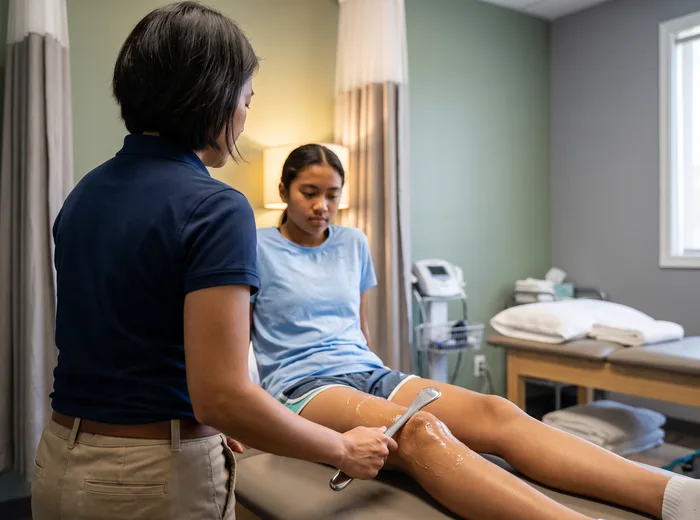
Prehab before, progressive rehab after. The strength you build in advance shortens what comes next.
Back Pain & Sciatica
The most common reason people call us. We find the driver, whether it is the disc, the hip, or the pelvic floor.