Tailbone Pain Treatment in Palm Desert
Sitting hurts. Standing up from sitting hurts more. You bought the cushion and were told a bruised coccyx just needs time. Months later it is still deciding where you can sit and how long for.
What causes tailbone pain?
The coccyx is a small stack of bones at the base of your spine, and it is anything but passive. Pelvic floor muscles, the anal sphincter, a ligament running from the sacrum, and part of the gluteal muscle all attach to it, so the tailbone gets pulled by whatever those tissues are doing. That is why coccydynia often has little to do with damage to the bone, and why treatment aimed only at the bone rarely holds.
Landing on the coccyx, on stairs, on a hard court, off a bike, can bruise it and occasionally fracture or dislocate it. The bone itself usually settles. What often does not settle is the reflexive spasm of the pelvic floor muscles that clamped down to protect it, and that spasm keeps tugging on the coccyx long after the injury heals. It is why pain from a fall years ago can still be here today, and why releasing muscle is what changes it.
The coccyx moves out of the way during a vaginal delivery, and sometimes it is pushed further than it comfortably returns from, or the ligaments holding it are strained. A long second stage, an assisted delivery, or a big baby all raise the odds. Tailbone pain after birth is common, rarely mentioned to anyone, and very treatable, whether the birth was last month or years ago.
Sitting slumped back onto your sacrum loads the coccyx directly, and hours of it daily keeps the surrounding muscles short and the local tissue irritated. Hard chairs, long drives across the Valley, cycling saddles, and a work seat you never get out of all qualify. There is usually no single injury to point at, which is exactly why people put up with this one for years before mentioning it.
This is the driver most often missed. When the deep pelvic floor muscles hold in a shortened, tender state, they pull the coccyx forward and keep it under constant tension, so sitting hurts and standing up hurts more as those muscles change length. The pain can spread into the rectum, the low back, and the back of the thigh. Imaging looks normal, and the pain is entirely real.
The coccyx is supposed to flex slightly as you sit and release as you rise. Some move too much and some barely move at all, and both hurt. A hypermobile coccyx pinches tissue at the end of its range, while a stiff one forces the surrounding muscles and the sacrum to absorb load they were not built for. Assessment tells us which one you have, because the treatment is different.
Every hard push loads the pelvic floor and the coccyx together, and a full rectum sits directly against them. That is why tailbone pain and difficult bowel movements so often turn up in the same person, and why the pain flares for days after a bad stretch. How you sit on the toilet and how you empty are not side notes here. Fixing them is often what keeps the relief from unraveling.
How physical therapy in Palm Desert helps.
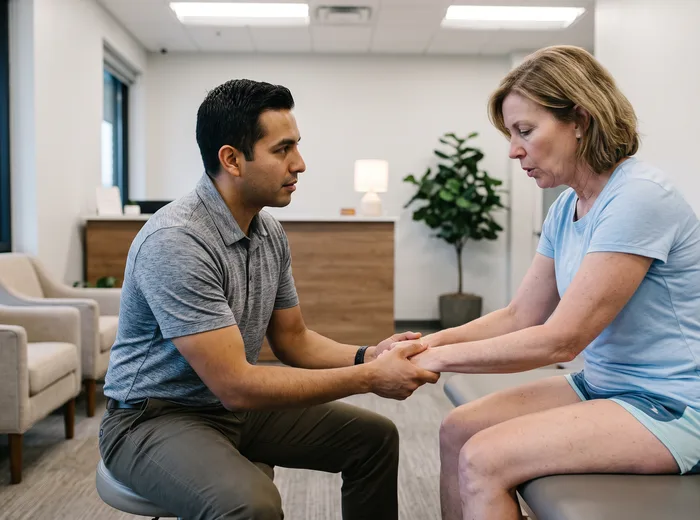
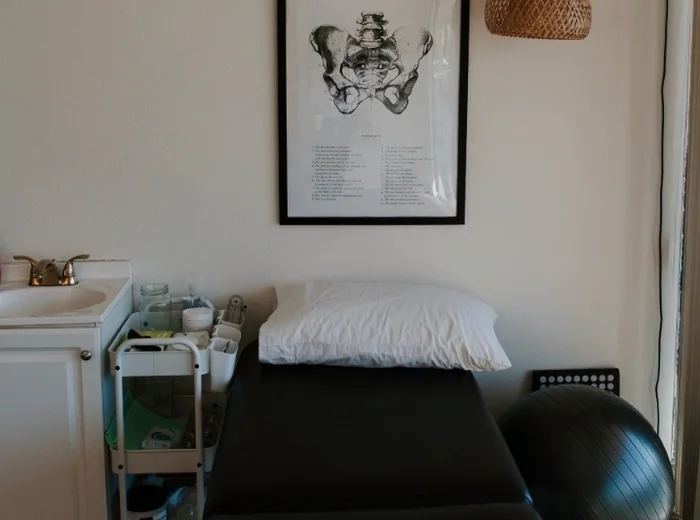
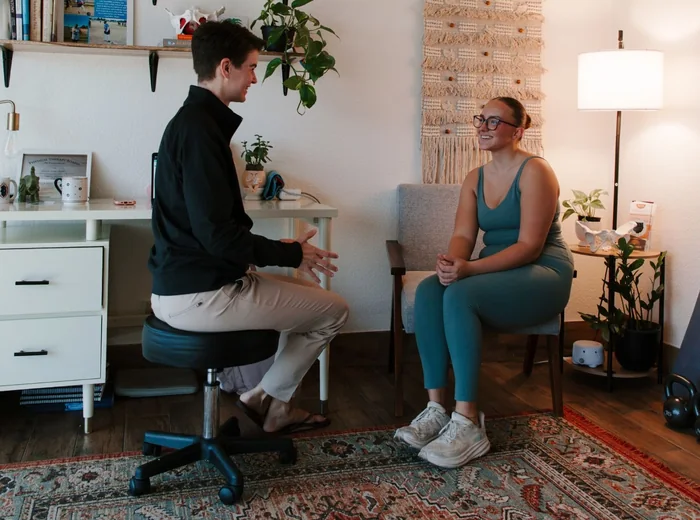
Coccydynia responds well to hands-on care, and it is one of those conditions where the assessment changes everything, because identical pain can come from a stiff coccyx, a hypermobile one, or muscles in spasm around a perfectly normal bone. Your evaluation is a full hour with Dr. Sarah Hare, PT, DPT, PCES: how you sit, how you stand up, what your hips and low back are contributing, how the tissue around the coccyx tolerates pressure, and how the muscles attaching to it are behaving. Because those muscles attach to the tailbone from the inside, an internal assessment gives information no external test can, so it is explained in full before anything happens. It is always your choice, it can be declined or stopped at any point, and plenty of effective treatment happens entirely externally: external coccyx mobilization, gluteal and hip work, sacral mobilization, and soft tissue release through the low back. Treatment then pairs manual therapy with the practical part. How to sit, what to sit on, how to get up without provoking it, how to empty your bowels without straining, and graded strength for the hips and trunk so the area stops carrying more than its share. Nothing about this is unusual to talk about, and nobody here will be surprised by where it hurts. Most people notice a change in the first few visits, and whether the plan is working is clear within two or three weeks.
What to expect from your recovery.
Finding what is pulling on it
A full hour of assessment: sitting and standing mechanics, hips, sacrum, low back, external coccyx mobility, and, only with your consent, the muscles attaching from the inside. You leave knowing whether your coccyx is stiff, too mobile, or being pulled, and what that means for treatment.
Hands-on release and mobilization
Treatment starts by taking tension off the tailbone. Manual release of the pelvic floor, gluteal, and low back tissue, coccyx and sacral mobilization graded to what you tolerate, and immediate changes to how you sit and rise so the area gets a break between visits. Sitting tolerance is the number we track, and it usually moves first.
Sitting and living without planning around it
Once the pain settles we build capacity: hip and trunk strength, bowel mechanics that do not require straining, and a return to driving, desk work, cycling, or whatever you stopped. You leave with a short maintenance routine and a clear plan for a flare, so a hard week does not turn into another lost year.
Sara was incredibly helpful to me when I suffered a twist in my back in combination with a stick pelvic.
Pain rarely travels alone.
Back Pain & Sciatica
The most common reason people call us. We find the driver, whether it is the disc, the hip, or the pelvic floor.
Pelvic Organ Prolapse
Heaviness, pressure, or a bulge that gets worse as the day goes on. Prolapse responds to targeted pelvic floor work.
Hip & Knee Pain
Weight-bearing joints rarely fail alone. We treat the joint and the mechanics feeding it.