Pre and Post Surgical Rehab in Palm Desert
Surgery repairs a structure. It does not restore a function. Prehab before, and cleared, graded rehab after, whether the operation is on a joint, your abdomen, or your pelvis.
What causes a slow recovery after surgery?
Whatever the operation was, you come out of it with three things at once: tissue that is healing, muscles that stopped firing, and a body that has been holding itself carefully for weeks. Most of what people call a slow recovery is those three things left unaddressed long enough to harden into a new normal. Almost all of it responds to rehab. A fair amount of it can be pre-empted before the surgery date, and the rest is very treatable afterward once your surgeon says you are ready.

Pain and waiting both cost strength. By the time an operation is on the calendar you have usually spent months moving less, and whatever you have lost is what you wake up with. Prehab spends those weeks loading what you still can, teaching the exercises you will be asked for afterward, and rehearsing the transfers you will need on day one. Less of it is new when it matters.
Healing tissue lays down fast and not neatly, and it adheres to whatever is adjacent. A C-section scar can bind to the layers underneath it. A hysterectomy or abdominal incision can restrict how the tissue beneath it slides. A joint incision can tether skin to muscle. The scar itself looks fine, which is why this gets missed, and the tissue under it does not move. That shows up as pulling, numb patches, or pain a long way from the scar.
After abdominal or pelvic surgery the deep muscles often go quiet, and they do not come back simply because time has passed. You brace with the wrong things, your low back takes over, and leakage, pressure, or a heaviness that was not there before can turn up months later and feel unrelated. Retraining is specific and it has an order: breath first, then coordination, then load. Squeezing harder is not that.
For weeks after surgery you move carefully, and careful means the same narrow pattern repeated all day long. You stop rotating your trunk. You lead with one leg on every stair. You hold your breath to get off the couch. Then the tissue heals and the pattern stays, and the pattern is what keeps hurting. Naming the habit out loud is usually the first time anyone has.
Most people are released from surgical follow-up once the wound has healed, which is not the same as being ready to lift, run, or pick up a toddler. Without a graded return you either stay under-loaded and fragile, or you jump back in at full volume and flare. Progressive loading is the least interesting part of rehab and the part that decides whether the result holds.
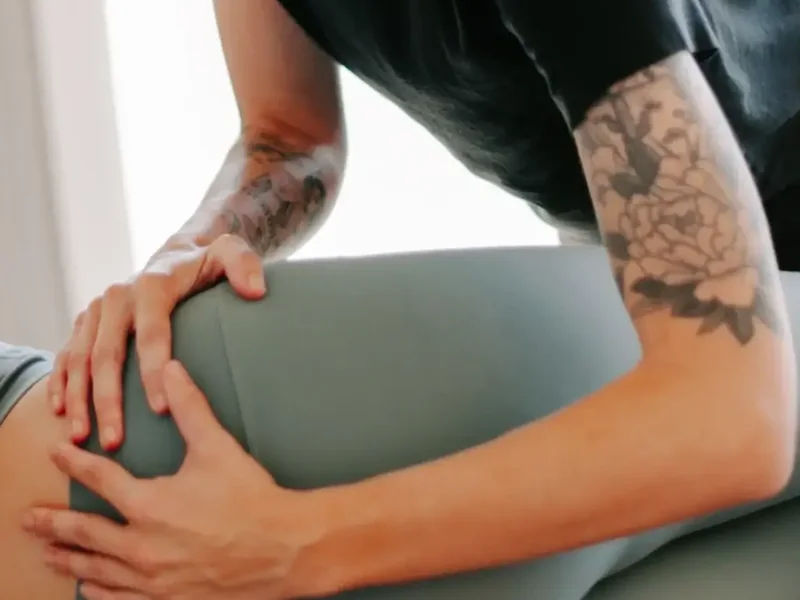
How physical therapy in Palm Desert helps.
This page covers both halves of an operation and both kinds of surgery. Orthopedic: hip and knee replacement, shoulder and knee procedures, repairs after a fracture. Abdominal and pelvic: C-section, hysterectomy, prolapse repair, and other abdominal surgery. Dr. Sarah Hare, PT, DPT, PCES, treats both, which is unusual in one practice and useful if your surgery sits between the two, because an abdominal incision is also a core problem and a hip is often also a pelvic floor problem. Before surgery, prehab builds strength and range while there is still time, and rehearses what the first week will ask of you. After surgery, everything starts with your surgeon: we work from their protocol and their clearance, and nothing hands-on happens near an incision until they confirm the tissue is ready. Once it is, treatment moves through soft tissue and scar work to restore the slide between layers, then breath and coordination to bring the deep muscles back online, then graded loading toward the thing you actually want to do again. Internal pelvic assessment is available where it is relevant, and it is always your choice, explained in full before anything happens, and easy to decline without losing access to effective treatment. Plenty of good work happens externally. Every visit is a full hour, one on one, in the Palm Desert clinic, with the same Doctor of Physical Therapy from prehab through discharge. California is a direct access state, so you can start without waiting on a referral.
What to expect from your recovery.
Prehab and a plan for day one
If surgery is still ahead of you, that time gets used. We test what is strong and what is not, load what your body allows, and teach the exercises and transfers you will be asked for afterward. You go in knowing your precautions and your first week, which is most of what turns a frightening recovery into a managed one.
Early post-op: cleared, gentle, specific
We begin when your surgeon clears it and we stay inside their protocol. Early sessions manage swelling, restore the range you are permitted, and wake the deep muscles with breath and coordination work. Scar and soft tissue work starts once the incision is ready for hands, not before.
Loading back into your actual life
The last phase is graded strength toward whatever you named at the first visit: lifting a grandchild, hiking a Valley trail, sleeping on that side again, running. Progress is measured out loud at each visit, and when the plan stops moving we change it rather than repeat it.
I've been working with Inclusive Pelvis Wellness from my third trimester through postpartum and I don't know what I'd do without Sarah as part of my care team.
Pain rarely travels alone.

Hip Replacement Surgery
Prehab before, progressive rehab after. The strength you build in advance shortens what comes next.

Abdominal Pain
Scar tissue, visceral restriction, and a core that stopped firing. We work the abdomen the way we work any other joint.

Endometriosis
Pelvic floor tension and adhesions amplify endometriosis pain. Hands-on care addresses what medication cannot reach.